Kidney Transplant
If you have kidney disease, treatments can help prevent further damage to your organs. But if you have a severe or long-term condition that permanently damages your kidneys — like diabetes or high blood pressure — you may develop kidney failure that requires dialysis.
A kidney transplant may be the best option for those with advanced kidney disease. A kidney transplant replaces a damaged kidney with a healthy one. Kidney transplantation at University Health could allow you to stop dialysis and start on the path to a healthier, longer life.
Benefits of Kidney Transplant
A kidney transplant can provide health benefits such as:
- The option to discontinue dialysis
- Increased life expectancy compared to dialysis
- Enhanced quality of life through improved health and energy
- Regained sense of independence
Types of Kidney Transplants
We perform three types of kidney transplants. Your doctors will review your options with you and help you understand which is best for your situation.
Deceased Donor Kidney Transplant
Your new kidney comes from a deceased donor as it becomes available through the national computerized waiting list known as United Network for Organ Sharing (UNOS).
Living Kidney Donor Transplant
Your new kidney comes from a living donor. This could be a family member, friend, loved one or someone you’ve never met but who wants to donate their kidney (altruistic donor). You may be able to receive a kidney transplant more quickly this way. Learn more about living kidney donor transplants on our website.
Kidney Paired Donation
Sometimes, your loved one wants to donate a kidney but finds they aren’t a match with you. When this happens, we work with other donor/recipient pairs to coordinate a kidney exchange so both recipients receive a compatible kidney. This is called a kidney paired donation, and it helps two people get kidneys who may otherwise have to wait longer to find a match.
The Transplant Process
Your transplant patient journey at University Health will be similar to the following:
Your First Visit
On your first visit, meet your entire transplant care team, including a nephrologist (kidney specialist), surgeon, dietitian, social worker and financial counselor, if needed. Come prepared with a list of questions and a support person to help you remember everything you and your team discuss.
Evaluation Testing
You’ll undergo some testing to determine if you are a candidate for transplant. In addition to a physical exam and review of your entire health history, your doctors may also order:
- Blood tests
- Tissue typing
- Chest X-ray
- Colonoscopy
- Mammogram
- Pap smear
- Prostate-specific antigen (PSA) test (for men)
- Radiology testing
- Tissue Typing
Becoming a Candidate for Transplantation
The University Health Transplant Patient Selection Committee will review your health history and test results to determine if you are a candidate for transplant. Your transplant coordinator will notify you of the committee’s decision. You may be placed on the national transplant waitlist or will discuss alternative treatment options with your care team.
Living Kidney Donation
This involves receiving a kidney from a living donor. It may be someone you know or don't know. Living kidney donations often result in better short- and long-term outcomes. Plus, there is no need to be on the waitlist for a deceased donor, so you will get a transplant sooner.
Kidney Transplant Waiting List
When you are approved for transplant, you will be placed on the national kidney transplant waiting list through the United Network for Organ Sharing (UNOS). The average wait time for a kidney is six years. While you are waiting, you can continue your regular health care with your provider and may want to look for a living donor.
Kidney Transplant Surgery
Your care coordinator will notify you when a deceased donor has become available. You’ll head straight to University Hospital for your surgery, which lasts between 2-4 hours. If you receive a deceased donor kidney, your surgeon will make an incision above your groin, remove your kidney and then attach the new kidney to your arteries, veins and ureter (tube that connects the kidney to the bladder).
If you receive a living donor kidney, you and the donor will both undergo minimally invasive surgery with the da Vinci ® Robotic Surgical System. This is less invasive than traditional kidney transplant surgery and allows for a faster recovery time.
After Kidney Transplant Surgery
After kidney transplant surgery, you will recover in the intensive care unit, where your family can visit you. Most people recover in the hospital for five or six days while our team monitors the function of your new kidney.
Before you go home, we’ll review transplant care education materials and medications with you and your family so you can feel confident about staying healthy and monitoring for post-transplant complications. We’ll also schedule you for your first post-transplant follow-up visit.
Become a Living Donor
Start the living donor process by completing a donor health history questionnaire.
Why University Health for Kidney Transplant?
 Since 1985, our team has performed more than 3,000 kidney transplants, including combined kidney-pancreas transplants and living-donor kidney transplants.
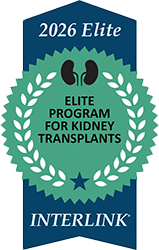
University Health Transplant Institute is the top kidney transplant program in South Texas with high patient success rates. We are also recognized by Interlink as an Elite Program for Kidney Transplants for our high-quality care and strong patient outcomes.
In addition to our transplant team’s experience, University Health Transplant Institute is the only transplant center in South Texas offering robotic surgery for living kidney donation, making us a leader in kidney transplants.
High-Quality, Recognized Kidney Care
Benefit from our team’s history of research, education, innovation, medical expertise and surgical excellence. Our program is a designated Center of Excellence by the following health plans and organizations:
- Aetna
- Blue Cross Blue Shield Association
- INTERLINK
- LifeTrac
- Optum Health
Top Patient Survival Rate in South Texas
Our commitment to our patients goes far beyond surgery. We provide comprehensive, long-term care to help patients and their new kidneys thrive for years to come.
Our kidney transplant program consistently achieves outstanding patient survival rates, according to the Scientific Registry of Transplant Recipients (SRTR).
Here are some highlights from 2024 to 2025 from SRTR:
- We performed 125 deceased donor kidney transplants and 55 living donor kidney transplants
- Higher-than-average one-year survival rate compared to the national average for deceased and living donation (99% versus 97%)
- 100% patient survivability 90 days post-living donor transplant
Increasing Organ Transplant Access Model
This kidney transplant hospital has been selected by the Centers for Medicare & Medicaid Services (CMS) to participate in the Increasing Organ Transplant Access (IOTA) Model. The IOTA Model aims to increase access to life-saving transplants for patients living with end-stage renal disease (ESRD) and reduce Medicare expenditures.
The University Transplant Institute uses established guidelines to assess whether someone is a good candidate for a kidney transplant. These guidelines help guide decision-making, but every patient is evaluated individually, and special circumstances may be considered on a case-by-case basis.
Living kidney donation is a voluntary, selfless act, and donors must meet specific medical, psychosocial, and lifestyle criteria to ensure safety and transplant success. Candidates must express interest in donation without being pressured or expecting anything in return. Learn more about our Living Donor Kidney Program Selection Criteria.