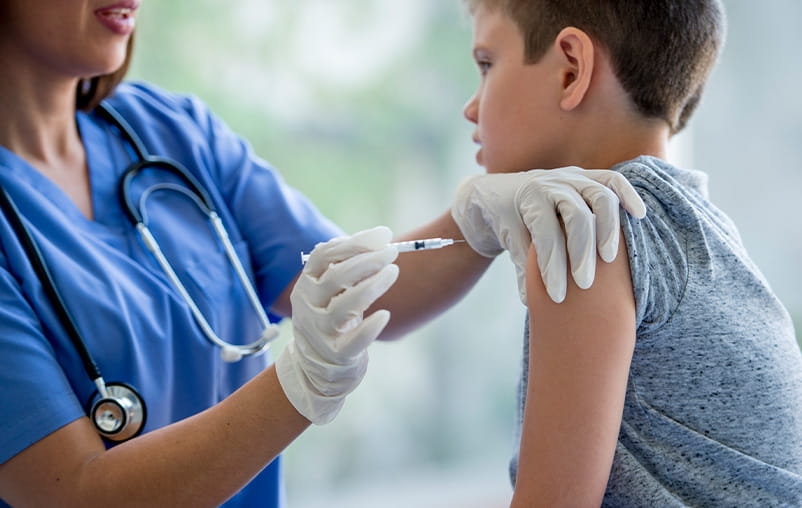

Vaccines were first introduced in 1796 and have been keeping children and adults protected from many different diseases for centuries now.
Some vaccines protect against infection, while others lower the risk of severe illness, complications, hospitalization and even death. They all play an important role in keeping the community and individuals healthy.
Because children are still developing their immune systems, staying up to date on recommended vaccines is especially important. Dr. Suzanne Rienstra, a pediatrician at University Health One Medical, explains why keeping up with your child’s vaccines matters.
Why Staying on Schedule With Childhood Vaccines Matters
Talk with your child’s pediatrician about which vaccines your child needs and when they should receive them. Most pediatricians follow the recommended childhood vaccine schedule developed by the American Academy of Pediatrics (AAP).
“The vaccine schedule is based on years of scientific research and is carefully reviewed by medical experts,” said Dr. Rienstra. “This is to help protect children when they are most vulnerable to serious illness.” Following the recommended schedule helps babies and children build protection against preventable diseases as their immune systems continue to grow and develop.
The AAP, along with other leading medical organizations, recommends staying up to date on childhood vaccines to help keep children and communities healthy.
Risks of Missed or Delayed Vaccinations
Skipping or delaying vaccines can put your child at risk of serious and even life-threatening illness. The World Health Organization explains that “for vaccines to work best, they need to be given before your child is exposed to these germs.”
That’s why most childhood vaccines are given within the first two years of life, providing your child with protection before exposure. Dr. Rienstra said: “The vaccine schedule is set up for children to receive a vaccine before they are exposed, and when the vaccine will work best.”
If vaccines are not given on the recommended schedule, they may not work as well. This can also leave your child unprotected and at risk of getting sick before they are vaccinated.
Protecting Your Child and the Community
Vaccines protect the person being vaccinated, but they also play an important role in protecting others and keeping them healthy.
Germs can spread quickly through communities. If enough people become infected, it can become an outbreak. Vaccination helps prevent that, but only when enough people are vaccinated.
When a certain number of people in the community are vaccinated, it establishes “herd immunity,” also called “community immunity,” which makes disease outbreaks much less likely.
That’s why certain vaccines are required for school enrollment in Texas and other states across the country. Texas, for example, requires vaccination against polio, diphtheria/tetanus/pertussis, measles/mumps/rubella, hepatitis B, varicella and hepatitis A to enroll in kindergarten and beyond.
Common Vaccine-Preventable Illnesses
Vaccines are available to protect your child against many diseases and illnesses, including:
- Diphtheria
- Measles
- Mumps
- Polio
- Rubella
- Tetanus
- Varicella (chickenpox)
- Whooping cough
While many of these diseases are now uncommon thanks to vaccines, illnesses such as measles have started to reappear in recent years in communities with lower vaccination rates.
Recommended Vaccine Schedule for Children
Some vaccines require only one dose, while others require multiple doses. The AAP explains that the timing of these doses is based on a child’s immune system age, which provides the best protection after vaccination and when the child is at greatest risk.
Key Vaccines by Age
The AAP recommends the following vaccines for children between birth and age 6:
- RSV: 1 dose during RSV season between birth and 6 months, another dose the following year if at high risk
- Hepatitis B: 1 dose at birth, 1 dose between 1 and 2 months, and another dose between 6 and 18 months
- Rotavirus: 1 dose at 2 months, 1 dose at 4 months, and 1 dose at 6 months
- DTaP: 1 dose at 2 months, 1 dose at 4 months, 1 dose at 6 months, 1 dose between 15 and 18 months, and 1 dose between ages 4 and 6
- Hib: 1 dose at 2 months, 1 dose at 4 months, 1 dose at 6 months, and 1 dose between 12 and 15 months
- PCV: 1 dose at 2 months, 1 dose at 4 months, 1 dose at 6 months, and 1 dose between 12 and 15 months
- IPV: 1 dose at 2 months, 1 dose at 4 months, and 1 dose between 6 and 18 months
- MMR: 1 dose between 12 and 15 months and 1 dose between ages 4 and 6
- Varicella: 1 dose between 12 and 15 months and 1 dose between ages 4 and 6
- Hepatitis A: 1 dose between 12 and 23 months with a second dose six months after the first
The AAP also recommends regular COVID-19 vaccines and annual flu vaccines in children ages 6 months and older, so talk with your child’s pediatrician about those vaccines and why they’re recommended.
The AAP recommends the following vaccines for children between the ages of 7 and 18:
- MenACWY: 1 dose between ages 11 and 12
- Flu: Annually
- HPV: 2 doses between ages 9 and 12, or 3 doses if given after age 15
- Tdap: 1 dose between ages 11 and 12
Talk with your child’s pediatrician about whether your child also needs the COVID-19 vaccine and the MenB vaccine.
How to Schedule Missed Appointments
If your child missed a vaccine, all you need to do is call your pediatrician’s office and explain what was missed. They can talk you through what’s required to get your child back up to date.
When vaccines are started later in life rather than at birth, your pediatrician may follow what’s known as a “catch-up immunization schedule.” This schedule can be used to get a child up to date on vaccines while making sure there’s still proper spacing between doses.
Combining Immunizations With Sports Physicals
If your child is participating in a school sport or another extracurricular activity, a sports physical may be required. This visit isn’t the same as a well-child checkup — it’s designed to make sure your child can safely participate in those activities.
A sports physical can be an opportunity to have your child receive recommended vaccines. If your child is due for a vaccine at the time of the physical, talk with your child’s pediatrician about getting that done during your appointment.
Communicating With Your Child’s Pediatrician
If you have concerns about vaccines or questions about what your child needs, talk with your pediatrician. Pediatricians have specialized training in the unique needs of kids, including all the vaccines they need.
While most kids should be vaccinated according to the AAP’s recommended schedule, some kids have individualized needs that require additional doses, alternative vaccine types or different spacing.
Pediatric Vaccination at University Health
At University Health, we make it easier for families to stay on track with childhood vaccines. If you have a University Health primary care provider (PCP), schedule an appointment online or call 210-358-5437.
If you don’t have an assigned PCP, we have our health centers are conveniently located within seven school districts making care more accessible for families and individuals.