

Innovation at work in the Harvey E. Najim Pediatric Emergency Department
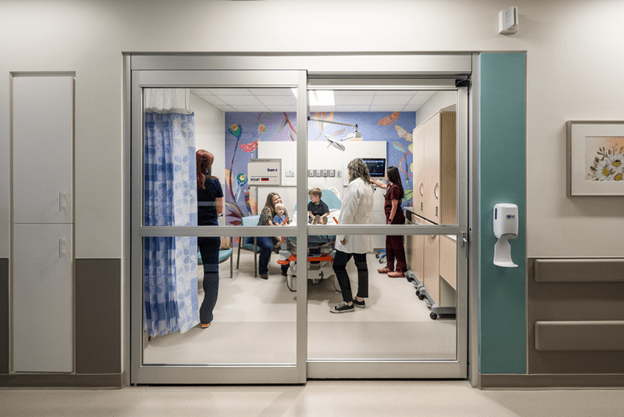
As the University Health Women’s & Children’s Hospital celebrates its two-year anniversary, within the Harvey E. Najim Pediatric Emergency Department (ED), an innovative mindset has quietly reshaped how care is delivered to some of the tiniest and most vulnerable patients.
“Before, these new mothers were navigating parking garages, multiple towers and busy lab spaces, sometimes just days after a C-section,” said Julyssa Gallegos, DNP, RN, ENP-BC, CEN, assistant director of Emergency Services. “They were overwhelmed, anxious and just trying to get in and out with their babies. We knew we could make that experience better.”
At University Health, excellence is no coincidence; it is a standard that is always evolving. Situated on the ground floor, families are welcomed at the Pediatric ED without the stress of elevators, crowded hallways or navigating the busy University Hospital. But beyond its convenient location and welcoming entrance, the true story begins once you walk into the facility.
When the emergency department was originally designed, private consultation rooms were included to support sensitive physician–family conversations. Today, those same rooms have evolved into something even more impactful.
Through an innovative program called the “Pediatric Fast Lane,” these spaces now serve as dedicated areas for convenient pediatric care.
According to Rocio Garcia, Executive Director of Emergency Services, the Fast Lane is not a traditional emergency visit. Instead, it is a specialized pathway that allows children to receive quick diagnostic services, such as newborn bilirubin checks, routine lab work, x-ray scans or screenings ordered by their provider, and today these important services are being facilitated through the consultation rooms.
“By bringing that care into these rooms with nurses who do this every day, we’re able to make the experience faster, safer and far less stressful,” Rocio said.
Whether it’s drawing labs from newborns with jaundice or performing x-rays on a young patient, these skills if done properly, require frequent exposure to a pediatric setting and the impact of this specialized approach is often visible in the children themselves.
“Many young patients return regularly for labs and quickly build relationships with the nurses who care for them,” Rocio said. “Over time, fear gives way to confidence, the children who once felt anxious walk in ready to be brave and trust the familiar faces who know exactly how to care for them.”
The privacy of these rooms has also created space for another critical layer of care, which is supporting mothers alongside their children. Maternal mental health screenings are also conducted in this space, helping care teams identify postpartum depression early and connect families with vital resources when they need them most.
“For many mothers, these spaces may be the first place they feel safe enough to talk about what they’re going through,” Julyssa said. “Having dedicated rooms gives us the privacy and calm environment needed to have difficult conversations about concerns mothers may not have realized existed or didn’t feel comfortable discussing elsewhere.”
What our experts at University Health have shown us is that caring for mothers and children requires more than treatment. It entails things like intentional spaces, early interventions and a program designed to support the entire family.
“Philanthropy has allowed us the opportunity to expand our services in different ways,” Julyssa said. “Because of the support of Harvey Najim and other donors, we have been able to significantly decrease our pediatric mortality rate in the last year.”
As University Health advances toward its vision of becoming one of the nation’s most trusted health care institutions, philanthropy will remain the fuel for its innovation, clinical excellence and a holistic care experience for patients and families.
To learn more about how you can support pediatric care at University Health, please contact the Foundation at 210-358-9860 or email Foundation@uhtx.com.