
At first, Robert McDonald thought his journey as a living donor was over.
In 2024, a close friend and mentor needed a liver transplant, and Robert immediately volunteered to help. After months of testing and evaluations, his friend ultimately received a transplant from another donor. When the transplant team at University Health Transplant Institute told Robert his case could be closed, he made a different choice.
“They said, ‘You know, feel free to keep your case open to donate,’” Robert recalled. “I said, ‘Sure, why not?’”
“Of course,” he said. “Whatever you need.”
What Robert did not realize at the time was that his decision would spark something that had never been done before: the nation’s first seven-pair living-donor liver exchange. This was a chain of surgeries that gave seven patients a second chance at life.
For the University Health transplant experts, this exchange was more than a medical milestone. It demonstrated how innovation, trust and extraordinary generosity can create new possibilities for patients who may otherwise run out of options.
The Living Liver Donor Process
Living donor liver transplantation allows a healthy person to donate a portion of their liver to someone in need of a transplant. Because the liver can regenerate, both donor and recipient livers grow back over time.
But not every willing donor is compatible with the person they hope to help.
That’s where paired exchange comes in.
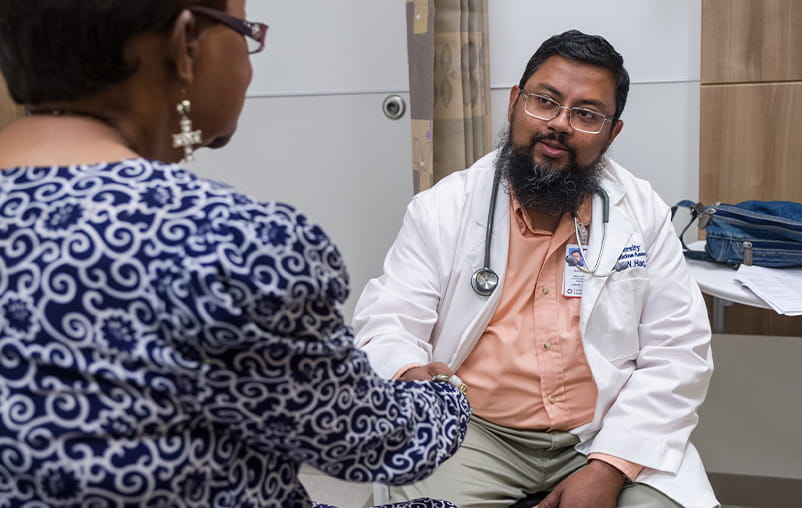
According to transplant surgeon Dr. Tarunjeet Klair, the seven-pair exchange pushed the boundaries of what had previously been possible.
“It’s hugely impactful because it tells us what the limits are and what we can do,” he said. “By doing liver paired exchange, we can now transplant people who have incompatible donors.”
A Chain Reaction of Hope
The chain began with Robert, who was willing to donate to a stranger. His liver donation allowed another donor to move forward for their intended recipient, which then freed another donor to help someone else — creating a domino effect across seven separate donor-recipient pairs.
“And without Robert McDonald, we wouldn’t have been able to do this,” Dr. Klair said. “He was absolutely critical to making this particular chain happen.”
Why Living Liver Donors Say the Decision Was Worth It
For many of the donors, the decision felt surprisingly simple.
“I didn’t choose organ donation because it was easy,” donor Tana said during a gathering where donors and recipients met one another for the first time. “I chose it because it mattered.”
Tana initially hoped to donate directly to her father, Jody Lewis. When her liver was found to be incompatible, she still chose to move forward as part of the paired exchange chain.
“Giving a part of my liver wasn’t a loss,” she said. “It was a purpose.”
Another donor, Lindsay, said donating on behalf of her mother, Norma, never felt like a sacrifice.
“Everybody said I was doing something so selfless,” she said. “But to me, it was the most selfish decision I’ve ever made. My mom is my best friend. I couldn’t imagine a day without her.”
Again and again, donors described the same motivation: if they had the ability to help save a life, they wanted to do it.
“You don’t have to be a superhero with a cape to save a life,” Tana said. “You can be an ordinary, everyday person just like me. You just have to say yes and step forward.”
How Living Liver Donation Gives Patients a Second Chance
For recipients, those “yeses” meant more time with the people they love most.
Recipient Vidal spoke emotionally about wanting to be present for his grandchildren’s lives after his health rapidly declined from liver disease.
“I want to be here to watch them graduate from high school,” he said. “I want to be around when they get married and have kids.”
Before his transplant, Vidal said he had started forgetting things and growing weaker. But despite the seriousness of his condition, he said he was never afraid of going into surgery because of the confidence he had in the transplant team.
“There was never any fear in me at all,” he said. “I knew everything was going to be good.”
Recipient Regina Peña, who was diagnosed with cirrhosis in 2017, shared that she never believed her transplant day would come.
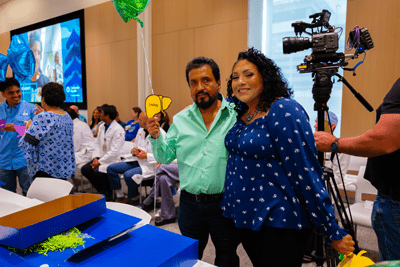
“Now I have the opportunity to see my granddaughter and my three grandsons,” she said. “I never thought I would get to meet him.”
For many families, the paired exchange offered hope when a direct donation was no longer possible.
Norma Cardenas’ daughter, Lindsay, initially volunteered to donate directly to her mother, but was not a match. Through the exchange program, both women were still able to move forward with surgery.
“To my daughter, your selflessness has given me a second chance at life,” Norma said. “You are my hero.”
Why University Health Is a National Leader in Living Donor Liver Transplantation
The historic exchange did not happen overnight.
According to Dr. Klair, the achievement was the result of years spent building the expertise, infrastructure and multidisciplinary support needed to perform increasingly complex living donor liver transplants.
“This could not have been done without the work that we’ve done over the last five or six years building up to this moment,” he said.
Today, University Health is recognized as the nation’s top-ranked liver transplant program by INTERLINK and the only transplant program for children in South Texas.
But for Dr. Klair, the impact extends beyond San Antonio.
“This absolutely needs to be adopted at a wider scale,” he said. “If somebody else looks at this and says, 'Maybe we can do this too', that would make my day.”
He hopes the seven-pair exchange becomes a model for transplant centers across the country and is a reminder to patients that more options may exist than they realize.
Why Becoming a Living Liver Donor Matters
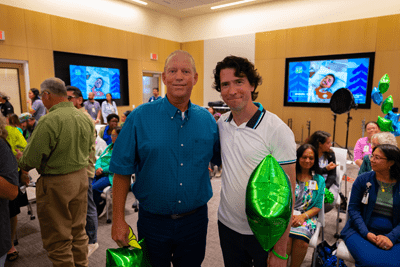
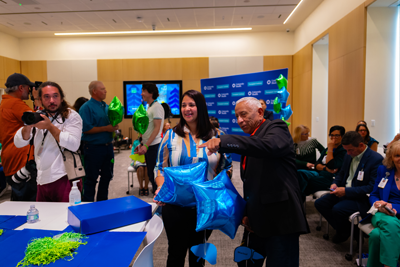
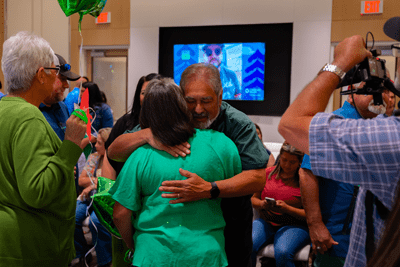
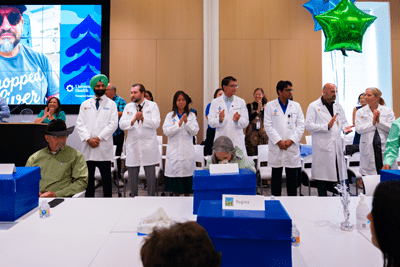
During an emotional reveal ceremony, donors and recipients finally met face-to-face, many embracing through tears as they learned whose lives had become forever connected through the chain.
What united everyone in the room was the understanding that a single act of generosity can ripple far beyond one person.
“One decision made with faith and love can change more than one life,” donor Marisol said.
Learn more about becoming a living liver donor at University Health.